
OKEYHAUL shipping: packing, weight and route comparison
Prepare an OKEYHAUL parcel and compare shipping routes to the US, UK or Europe. Check which items a route accepts, how the parcel will be packed, what weight is used to calculate the price and how to track it.
Choose inspected, eligible items first, then compare routes using the final outer dimensions, weight and packaging. For a route using dimensional billing, the chargeable weight can exceed the scale weight. Check the recipient, content restrictions, destination charges and claim conditions before approving the parcel.
Quick checklist
- Finish QC and resolve item returns before packing.
- Confirm route eligibility for every item and the actual destination.
- Compare the final weight, dimensions and complete quote.
- Save the packing list, service conditions and tracking references.
Select the items that are ready
Start with inspected items and a clear list of order references and quantities. Leave unresolved returns and unarrived orders out of the parcel. Check the oldest storage deadline before waiting for another purchase. Combining more items can change freight and protection needs; it does not automatically reduce the delivered total.
What changes when shipping to the US, UK or Europe?
Check the full recipient address, contact details and postcode or ZIP code. Use the correct US destination, distinguish Great Britain from Northern Ireland, and select the actual receiving country for Europe. EU member states, Norway and Switzerland should not be treated as one destination with identical route conditions.
| Destination | Before choosing a route | Before dispatch |
|---|---|---|
| United States | Confirm coverage for the ZIP code, product type and current entry method | Keep origin, descriptions and payment evidence; identify which duties are included. |
| Great Britain | Check postcode coverage and how VAT, duty and clearance are handled | Keep the tax-payment record and recipient contact details. |
| Northern Ireland | Select the actual destination rather than assuming Great Britain treatment | Ask how the route handles the applicable customs and tax arrangements. |
| EU country | Select the receiving member state and review low-value import handling | Confirm what is prepaid and retain any VAT and duty records. |
| Other European country | Check that country’s route coverage and import process | Do not apply EU rules automatically to Norway or Switzerland. |
Scroll horizontally to view all columns.
Check every type of content
A route that accepts clothing may apply different rules to perfume, liquids, batteries or other restricted contents. Describe the real item and confirm eligibility with the provider. Do not conceal a restricted item in a mixed parcel or assume that choosing a different category changes what the contents are. Separate parcels may be necessary.
Choose packaging for protection
Decide which retail boxes, accessories and seals must remain. Shoe boxes, structured bags, caps and fragile bottles have different needs. Ask how removing packaging affects both protection and any remaining return eligibility. Record the instructions instead of relying on a general request to make the box as small as possible.
Use compression only where suitable
Ask whether compression or vacuum packing is appropriate for the selected garments. Structured goods, fragile presentation boxes and winter clothing should not automatically receive the same treatment. A reduction in outer volume is useful only when the remaining protection and handling are suitable for the contents.
How is dimensional or volumetric weight calculated?
An early estimate helps with budgeting, but replace it with the quote for the actual packed parcel. Check outer dimensions, scale weight and the route’s chargeable-weight calculation. The sum of individual item weights does not establish the final billed amount once packaging and dimensional rules are included.
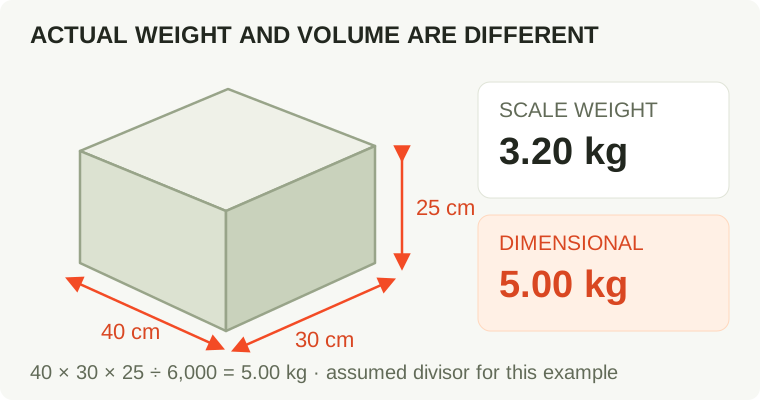
Assumed dimensional-weight formula
Dimensional weight in kg = length × width × height in cm ÷ the route divisor. With an assumed divisor of 6,000, a 40 × 30 × 25 cm parcel gives 30,000 ÷ 6,000 = 5.00 kg. If actual weight is 3.20 kg and this route bills the higher figure, the starting chargeable weight is 5.00 kg. A different divisor produces a different result.
| Measure | Larger package | Smaller suitable package |
|---|---|---|
| Outer dimensions | 40 × 30 × 25 cm | 35 × 25 × 20 cm |
| Actual weight (assumed unchanged) | 3.20 kg | 3.20 kg |
| Dimensional weight | 5.00 kg | 2.92 kg |
| Higher of actual and dimensional | 5.00 kg | 3.20 kg |
| Billed weight under this assumed rule | 5.00 kg | 3.50 kg |
Scroll horizontally to view all columns.
Translate the weight into an example quote
If an assumed route charges CNY 60 for the first 0.5 kg and CNY 20 for each additional 0.5 kg, 5.0 kg costs 60 + 9 × 20 = CNY 240; 3.5 kg costs 60 + 6 × 20 = CNY 180. This excludes other charges. Repacking may also change actual weight, so measure again and compare protection before accepting the revised quote.
How should I compare two shipping routes?
Use the same contents, destination and packaging when comparing complete quotes. Review tracking, delivery arrangements, transit estimates, exclusions, compensation conditions and selected extras. Ask which taxes and clearance charges are included; use the customs guide for the destination-specific questions rather than relying on an old allowance or a route name.
| Field | Route A | Route B |
|---|---|---|
| Destination and accepted contents | [confirm] | [confirm] |
| Final billed weight and rounding | [quote] | [quote] |
| Freight, packaging and extras | [amount] | [amount] |
| Tax and clearance inclusions | [list] | [list] |
| Tracking and local carrier | [details] | [details] |
| Transit estimate and exclusions | [details] | [details] |
| Claim trigger, deadline and cover | [details] | [details] |
| Complete expected cost | [amount + unresolved charges] | [amount + unresolved charges] |
Scroll horizontally to view all columns.
Approve the parcel and keep the record
Check the item list, recipient details, packaging instructions, route and payment amount before dispatch. Save parcel photos if provided, the final packing list, quote and service conditions. Keep the parcel reference separate from the purchase-order references so a later delivery enquiry identifies the correct shipment.
What should I do if parcel tracking stops?
Keep international and local tracking numbers where available. A gap between scans does not alone establish loss, and a transit estimate is not a guaranteed arrival date. Use the provider’s investigation process if progress stops. At delivery, compare the contents with the saved list and follow the receiving guide if anything is damaged or missing.
| Tracking situation | Next action | Useful reference |
|---|---|---|
| Label created, no acceptance scan | Ask whether the carrier has physically received the parcel | Parcel submission and handover dates |
| International movement pauses | Check the provider’s investigation trigger; request an enquiry when eligible | Last scan, route and parcel reference |
| Clearance request appears | Respond through the verified carrier channel before its deadline | Invoice / payment evidence and contents |
| Delivered but not found | Check proof of delivery, safe place and recipient details promptly | Delivery scan and local tracking reference |
Scroll horizontally to view all columns.
Common questions
Should every item go into one parcel?
Not necessarily. Content restrictions, storage deadlines, protection and the final quote can make separate parcels more suitable.
Does removing a shoe box always save money?
Compare the resulting packed quote and the protection needed by the actual item.
Does the shipping payment include customs charges?
Check the quote’s stated inclusions and exclusions. Freight and destination charges can be handled separately.
How many days will delivery take?
Use the quote for the actual destination and route. Separate seller dispatch, warehouse processing, carrier transit and customs time. A past shopper’s delivery time is not a promise for your parcel.
Should perfume travel with clothing?
Only if the selected route accepts the actual fragrance and mixed contents. Confirm the requirements before packing; a clothing route may not accept liquids.
Ready to browse products?
Choose a category to explore products and compare the details.
Explore categories